


0
The Australian Dollar remained under pressure during Tuesday's Asian session, with AUD/USD trading below the 0.6900 mark at around 0.6889, its weakest level since early April. Demand for the US Dollar continued to strengthen following renewed geopolitical tensions between the United States and Iran over the weekend, while expectations that the Federal Reserve could still tighten monetary policy later this year provided additional support for the Greenback. Investors are now waiting for the release of the Reserve Bank of Australia's (RBA) meeting minutes and China's official Purchasing Managers' Index (PMI) figures for fresh direction.
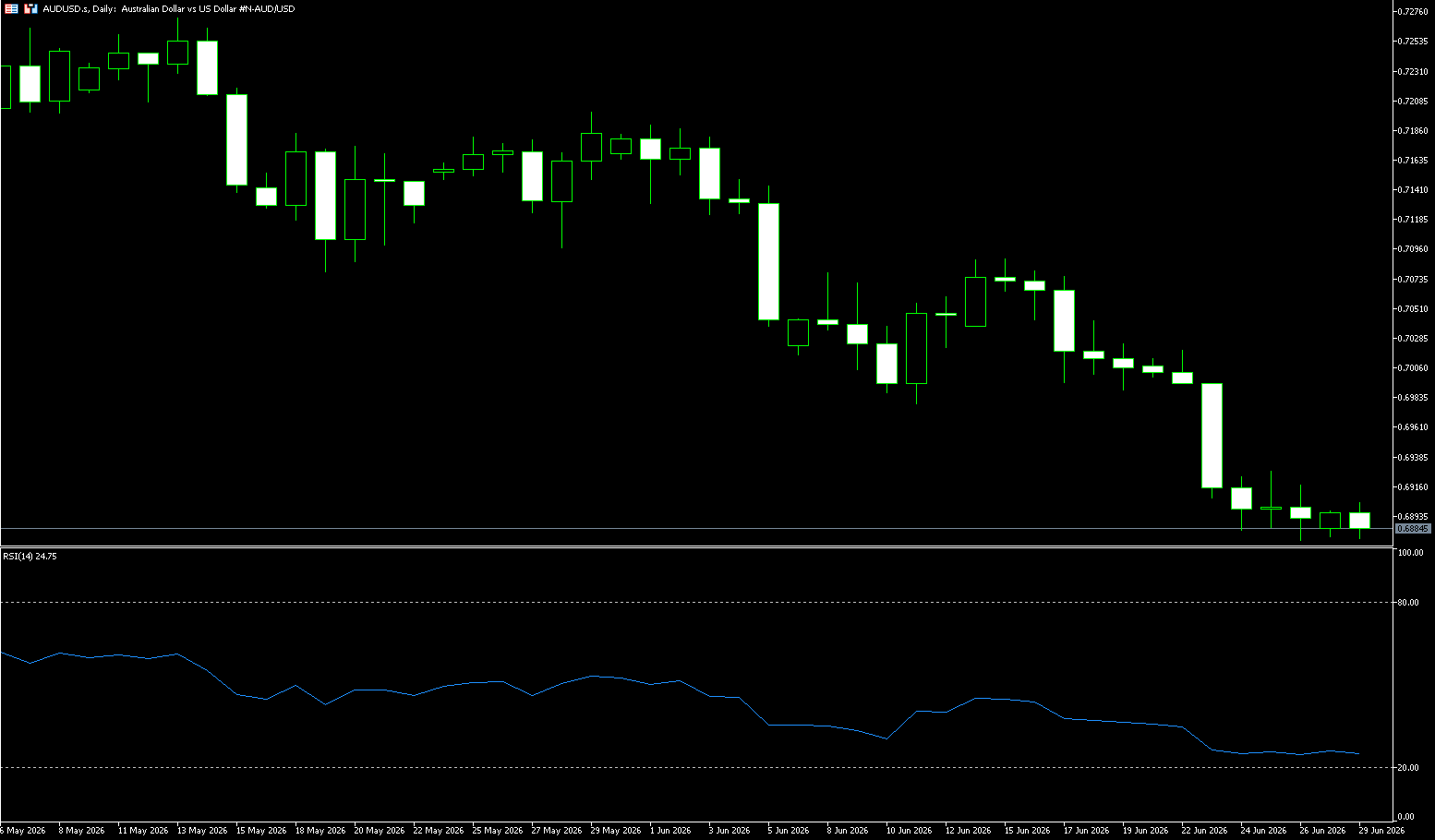
Technical outlook
On the daily chart, AUD/USD continues to trade beneath both its 55-day and 100-day simple moving averages (SMAs), which stand at 0.7118 and 0.7080 respectively. These levels now act as immediate resistance and reinforce the pair's bearish short-term trend.
Despite the recent weakness, the pair remains marginally above its 200-day SMA at 0.6861. Momentum indicators suggest selling pressure may be becoming stretched, with the Relative Strength Index (RSI 14) falling to around 27, indicating oversold conditions. At the same time, the Average Directional Index (ADX 14) remains close to 40, highlighting that the prevailing downtrend is still well established.
On the downside, the first key support is the 200-day SMA at 0.6861, followed by horizontal support at 0.6833. If these levels fail to hold, attention could shift towards 0.6660 and then 0.6593. On the upside, initial resistance is located at 0.7079, closely followed by the 100-day SMA at 0.7080 and the 55-day SMA at 0.7118. Above these levels, resistance is seen around 0.7278 to 0.7283 before the longer-term barrier at 0.7661.
Australian Dollar loses momentum
Although the Australian Dollar's broader medium-term outlook remains relatively constructive, recent price action suggests bullish momentum has weakened. The currency continues to be highly sensitive to shifts in global market sentiment. During periods of improving investor confidence, the Australian Dollar typically performs well. However, when geopolitical uncertainty rises and investors seek safety, the US Dollar tends to outperform.
While the longer-term outlook still favours gradual strength, near-term conviction has diminished as external risks continue to dominate trading conditions.
US Dollar strength and geopolitical risks remain key drivers
The Australian Dollar has now erased nearly all of the gains recorded between late March and mid-May. AUD/USD has declined for seven consecutive trading sessions and fallen below the important 0.6900 level, bringing the 200-day SMA near 0.6850 into focus.
The US Dollar has strengthened alongside renewed expectations that the Federal Reserve could still raise interest rates during the second half of the year. The US Dollar Index (DXY) climbed above the 101.00 level, reaching its highest reading since May 2025.
Although market concerns surrounding the recently announced US-Iran agreement have eased somewhat, geopolitical developments continue to influence investor sentiment and maintain demand for safe-haven assets.
Australian economy remains resilient
Australia's domestic economy continues to show resilience compared with many other developed economies.
The RBA maintained its Official Cash Rate at 4.35% during its latest meeting, reflecting ongoing concerns that inflation remains above target while recognising that previous rate increases are continuing to work through the economy.
Recent economic data have generally supported this cautious approach.
The preliminary June PMI survey showed Manufacturing improving to 51.2 from 50.7, while Services recovered to 49.9 from 48.7.
Australia's trade balance also improved significantly, recording a surplus of A$1.791 billion in April after a revised deficit of A$1.024 billion in March.
Economic growth, however, was softer than expected. Gross Domestic Product expanded by 0.3% quarter-on-quarter during the first quarter of 2026, slowing from 0.9%. Annual growth remained at 2.5%, although this also fell short of market expectations.
Labour market conditions continue to provide support. The unemployment rate eased to 4.4% in May from 4.5%, while employment increased by 40.6K after the previous month's revised decline of 40.7K.
Inflation has moderated but remains above the RBA's preferred range. Annual Consumer Price Index inflation slowed to 4.0% in May from 4.2%. Trimmed Mean inflation and the Weighted Median both increased to 3.6% from 3.4%, while Melbourne Institute Consumer Inflation Expectations edged down to 5.5% from 5.6%.
The RBA continues to project that inflation will return to target only around the middle of 2028. Financial markets currently expect the central bank to leave interest rates unchanged in August while pricing in roughly 10 basis points of additional tightening before the end of the year.
China provides stability but limited support
China continues to offer stability for Australia's export outlook, although it is no longer providing the strong growth impulse seen previously.
China's economy expanded by 5.0% year-on-year during the first quarter. Retail sales declined by 0.6% in May compared with a year earlier but remain 1.41% higher since the beginning of the year. Industrial production rose by 4.5%, exceeding market expectations.
Trade data also improved, with May's surplus widening to US$105.43 billion from approximately US$84.8 billion previously as both imports and exports strengthened.
Business activity showed signs of stabilisation. The National Bureau of Statistics reported Manufacturing PMI at 50.0, slightly lower than April's 50.3, while Services PMI returned to expansion territory at 50.1 from 49.4. Private sector surveys remained more optimistic, with Manufacturing at 51.8 and Services at 54.4.
Inflationary pressures remain subdued. Consumer prices increased by 1.2% year-on-year in May, matching the previous reading, while monthly CPI declined by 0.1%. Producer prices rose 3.9% over the past year.
Meanwhile, the People's Bank of China left its one-year Loan Prime Rate unchanged at 3.00% and its five-year Loan Prime Rate at 3.50%.
Overall, China is providing stability rather than acting as a major driver of stronger Australian Dollar performance.
RBA maintains cautious approach
The RBA kept the Official Cash Rate unchanged at 4.35%, broadly matching market expectations.
The central bank repeated that inflation remains too high and warned that additional rate increases remain possible if price pressures fail to ease sufficiently. Policymakers also highlighted concerns surrounding higher energy costs and reiterated their commitment to returning inflation to target.
Governor Michele Bullock adopted a more balanced tone following the meeting, noting that recent economic data had evolved broadly as expected and that there was no immediate need for further tightening. She also stated that Australia is not entering recession and that labour market conditions remain relatively tight.
Overall, the RBA continues to favour patience, allowing previous policy tightening to work through the economy while remaining prepared to act if inflation proves more persistent than expected.
Outlook for AUD/USD
The medium-term outlook remains cautiously constructive provided AUD/USD continues to trade above its 200-day SMA near 0.6850. However, additional gains are likely to require stronger improvements in global risk sentiment or renewed weakness in the US Dollar.
A sustained recovery could initially target the psychological 0.7000 level before testing 0.7200 and the 2026 high near 0.7280. Beyond that, the next major resistance stands at the 2022 peak of 0.7593.
Conversely, if geopolitical risks intensify, the US Dollar continues to strengthen or Chinese economic data disappoint, AUD/USD could break below 0.6860 and extend losses.
Positioning continues to unwind
Latest Commodity Futures Trading Commission (CFTC) data indicate that speculative investors further reduced exposure to the Australian Dollar during the week ending 23 June.
Net positioning declined to -13.0K contracts from -4.1K the previous week, marking a second consecutive week of net short positioning. Over the past four weeks, positioning has fallen by 73.2K contracts.
Open interest also declined sharply to 214.3K contracts from 295.5K, suggesting investors are primarily closing existing long positions rather than aggressively establishing new short positions.
Although speculative sentiment has weakened considerably, positioning remains relatively elevated by historical standards. Current net positioning still ranks in the 79th percentile of its five-year range, while speculative exposure remains around the 80th percentile.
This suggests the recent decline reflects investors reducing previously crowded long positions rather than signalling widespread conviction that a prolonged bearish trend has begun.
Key events to watch
Markets will closely monitor the release of the RBA meeting minutes alongside China's official PMI reports for further clues on Australia's economic outlook.
Beyond domestic data, AUD/USD is likely to remain driven by US Dollar performance, evolving geopolitical developments and overall risk sentiment. Additional downside risks include weaker Chinese growth, a more hawkish Federal Reserve, changing investor risk appetite or any unexpected shift in the RBA's policy stance.
Disclaimer: The information contained herein (1) is proprietary to BCR and/or its content providers; (2) may not be copied or distributed; (3) is not warranted to be accurate, complete or timely; and, (4) does not constitute advice or a recommendation by BCR or its content providers in respect of the investment in financial instruments. Neither BCR or its content providers are responsible for any damages or losses arising from any use of this information. Past performance is no guarantee of future results.
Lebih Liputan



Pendedahan Risiko:Instrumen derivatif diniagakan di luar bursa dengan margin, yang bermakna ia membawa tahap risiko yang tinggi dan terdapat kemungkinan anda boleh kehilangan seluruh pelaburan anda. Produk-produk ini tidak sesuai untuk semua pelabur. Pastikan anda memahami sepenuhnya risiko dan pertimbangkan dengan teliti keadaan kewangan dan pengalaman dagangan anda sebelum berdagang. Cari nasihat kewangan bebas jika perlu sebelum membuka akaun dengan BCR.
BCR Co Pty Ltd (No. Syarikat 1975046) ialah syarikat yang diperbadankan di bawah undang-undang British Virgin Islands, dengan pejabat berdaftar di Trident Chambers, Wickham’s Cay 1, Road Town, Tortola, British Virgin Islands, dan dilesenkan serta dikawal selia oleh Suruhanjaya Perkhidmatan Kewangan British Virgin Islands di bawah Lesen No. SIBA/L/19/1122.
Open Bridge Limited (No. Syarikat 16701394) ialah syarikat yang diperbadankan di bawah Akta Syarikat 2006 dan berdaftar di England dan Wales, dengan alamat berdaftar di Kemp House, 160 City Road, London, England, EC1V 2NX. Open Bridge Limited bertindak semata-mata sebagai pemproses pembayaran untuk BCR Co Pty Ltd dan tidak menyediakan sebarang perkhidmatan kewangan, perdagangan atau pelaburan bagi pihaknya. Peranan Open Bridge Limited adalah terhad kepada pemprosesan pembayaran.


 English
 简体中文
简体中文
 繁體中文
繁體中文
 Bahasa
Melayu
Bahasa
Melayu
 Tiếng
Việt
Tiếng
Việt
 ไทย
ไทย
 日本語
日本語
 한국어
한국어
 ភាសាខ្មែរ
 español